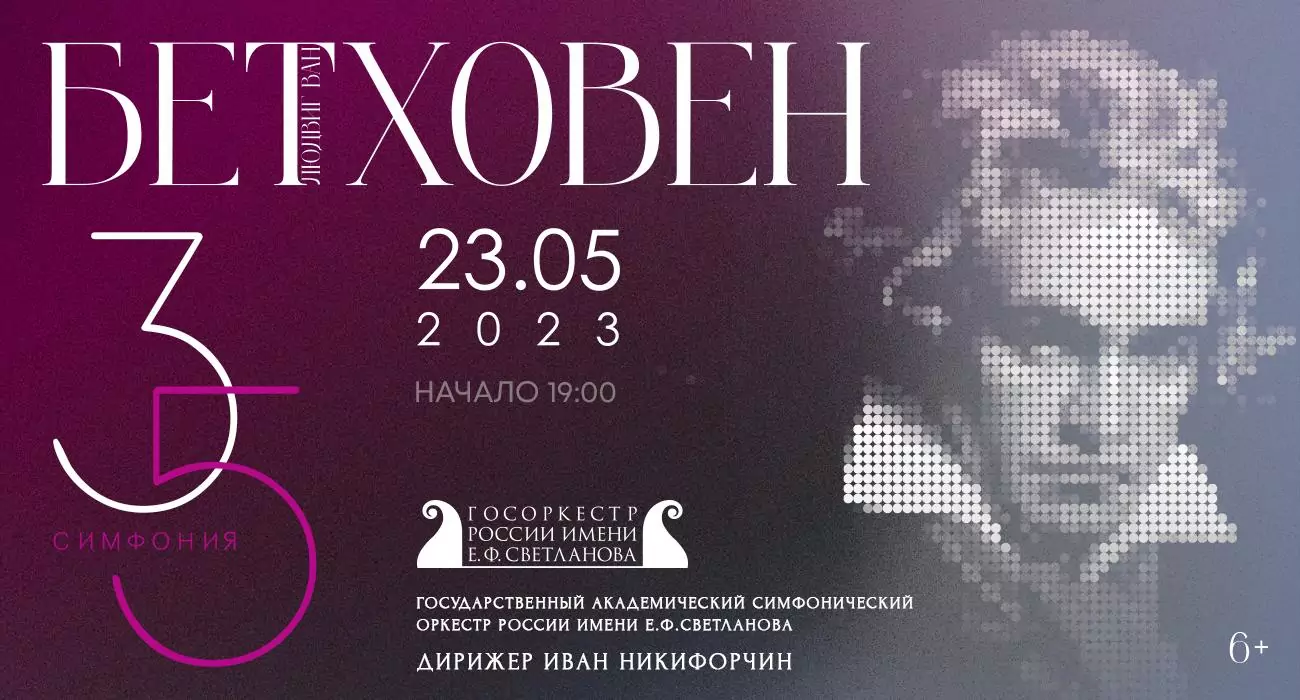
The State Academic Symphony Orchestra named after E.F. Svetlanov performed landmark works by Ludwig van Beethoven that evening. One of the country’s oldest symphony orchestras, it celebrated its 87th anniversary in 2023. Over decades of artistic activity, the orchestra has performed at the world’s most renowned concert venues under the direction of many distinguished conductors, collaborated with numerous celebrated musicians and ensembles, recorded hundreds of vinyl records and CDs, and made outstanding appearances at numerous festivals and competitions.
The conductor was Ivan Nikiforchin. He received his academic musical education at the Moscow State Tchaikovsky Conservatory and completed postgraduate studies there. Since 2015, he has worked with the State Academic Symphony Capella of Russia. He is the artistic director and conductor of the MGIM Symphony Orchestra at the A.G. Schnittke College, as well as the founder, artistic director, and principal conductor of the “Academy of Russian Music.” Ivan Nikiforchin performs with the country’s leading orchestras and regularly takes part in international competitions, awards, and festivals, achieving outstanding results.
Ludwig van Beethoven is one of the most frequently performed composers in the world. He wrote music in virtually every genre that existed in his time, despite being deaf for much of his creative life. At the May 23 concert, the audience had the opportunity to hear two of Beethoven’s famous symphonies, composed during the brilliant flowering of his genius.
Beethoven himself loved Symphony No. 3, known as the “Eroica,” more than any of his other symphonies. It played an important role in helping him emerge from a profound personal crisis caused by an incurable illness. In it, he expressed his deeply felt ideas about overcoming suffering through strength of spirit and the triumph of light over darkness after a fierce struggle. These ideas resonated strongly with the ideals of the French Revolution, which Beethoven wholeheartedly supported. Interestingly, the composer originally dedicated his Third Symphony to Napoleon Bonaparte. However, when Napoleon abandoned the ideals of the Revolution and proclaimed himself emperor, Beethoven furiously removed the dedication.
Symphony No. 3 is highly regarded by musicologists for the epic scale of its forms and the powerful musical imagery through which it conveys strength of will, the grandeur of death, and triumphant victory.
Similar “through struggle to victory” ideas are reflected in Symphony No. 5. It became the most popular work in Beethoven’s legacy and contains many of the most characteristic features of his musical style. At the same time, it is striking for its conciseness and tightly compressed forms. Beethoven worked on the Fifth Symphony longer than on any of his other symphonies — for a full three years.
The second half of the concert also featured the overture Coriolan, written by Beethoven for a production of the tragedy of the same name by Austrian playwright Heinrich Joseph von Collin. The play was based on the historical story of a Roman commander who betrayed his homeland and paid for it with his life. This is a highly unusual portrayal of a protagonist for Beethoven. Yet in this overture, the composer came closer than ever to the characteristic Romantic conception.
Beethoven is widely regarded as a key figure in the transition from the Classical era to Romanticism.