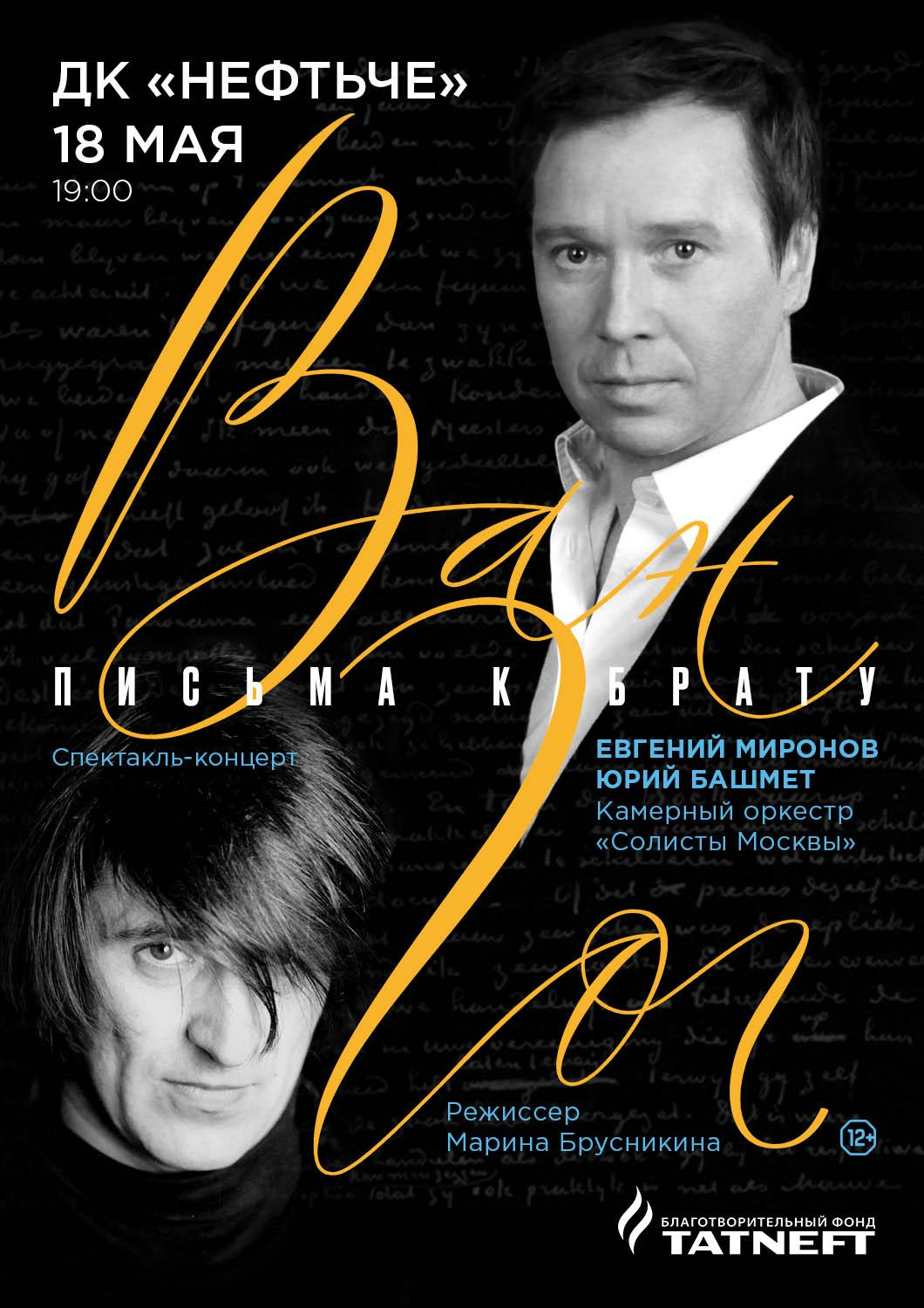
Van Gogh. Letters to His Brother — A Theatrical Concert
About the concert
On May 18, the stage of DK Neftche hosted a performance featuring letters written by Vincent van Gogh over different periods of his life, performed by People’s Artist of Russia Yevgeny Mironov.
Van Gogh’s letters to his brother Theo are an extraordinary and utterly unique document spanning hundreds of pages. They are a dialogue not only with the person to whom they were addressed, but also with himself, God and the world — the cries of a great artist struggling against despair.
Cast and creative team:
- Yevgeny Mironov
- Chamber Ensemble Moscow Virtuosi
- Artistic Director and Chief Conductor — Yuri Bashmet
- Adaptation and Stage Direction — Honored Artist of Russia Marina Brusnikina
Under the direction of Maestro Yuri Bashmet, the chamber ensemble Moscow Virtuosi performed:
- Alfred Schnittke — Yuri Bashmet: Trio Sonata for Strings
- Kirill Bodrov: Sunset for strings
- Ludwig van Beethoven — Gustav Mahler: Quartetto serioso in F minor, Op. 95
- Edvard Grieg: Norwegian Folk Song for strings, Op. 63 No. 1
- Johannes Brahms — Kirill Bodrov: Andante for viola and strings
- Gustav Mahler: Adagietto
Yevgeny Mironov describes the performance as the story of an artist who, despite everything life placed in his way, wanted until the very end to live and work and, without considering himself a great creator, leave behind something that might somehow justify his extraordinarily difficult life.
What could be more intimate than personal correspondence? What could be more truthful than letters to someone close to you, someone who seems to be your only source of support? Who could tell Van Gogh’s story better than Van Gogh himself?
Letters are meant to be read only by those to whom they were written. Van Gogh’s correspondence is a rare exception — an extraordinary body of work that would lose too much if it remained private. His letters to Theo are not simply a story of madness, but a complete autobiography: a life marked by small triumphs and painful setbacks, longing, patience, love, complaints and hopes for a better future.
The letters also offer a glimpse into Van Gogh’s creative process, allowing the reader to look beyond the canvas and into the depths of his art, into vast spaces where yellow, olive, flesh tones, azure and sky blue shimmer and blend. The magnificent play of color in his paintings is mirrored by the delicate, poignant play of words in his letters, through which one thought runs like a thread: “The sadness will last forever.”
These letters are not only the artist’s most revealing testimony about himself, or proof of his determination to follow his chosen creative path to the very end. They are also a story of extraordinary inner strength. Van Gogh’s correspondence offers a vivid portrait of a person who knew what he wanted from life and refused to abandon his dream.
Letter after letter, his story traces the journey of a man struggling with the most terrible form of suffering — loneliness. He was tormented by misunderstanding, rejection, criticism and the failure of others to share his hopes and dreams. Yet how did he preserve such unwavering faith in the path he had chosen despite all his doubts and failures?
The answer can be found in his letters: “The goal should be action, not an abstract idea.” Van Gogh was consumed by his work. He devoted himself entirely to painting and, until his final days, found meaning and strength in it.
Many considered him an eccentric, and some even dismissed him as insignificant. The one person who always believed in him was his brother Theo. Vincent often wrote to him, “We painted these pictures.” He knew that these were not merely beautiful words, but the truth.
Theo supported his brother throughout his life, believing that one day people would understand his painting and recognize his talent, and that Vincent would be able to earn a living through his work. Yet during his lifetime, Van Gogh sold only one painting.
Vincent van Gogh died at the age of 37 in 1890, still believing that the work to which he had devoted his life — painting — would never receive the recognition it deserved.
The final words are taken from Van Gogh’s letter to his brother Theo, found in the artist’s pocket on the day of his death, July 29, 1890:
“In essence, our paintings should speak for us. Yes, my dear brother, I have always told you, and I repeat once again, with all the seriousness of which persistent and concentrated thought is capable: I will never consider you an ordinary dealer in Corot’s paintings. Through me, you have taken part in the creation of certain paintings that remain calm even in the midst of a storm. We created them, and they exist — and that is the most important thing I wanted to tell you at a moment of relative crisis…”
Venue
Other concerts


Great Hall of the Conservatory
Moscow Virtuosi on the stage of the Great Hall of the Conservatory
Great Hall of the Conservatory
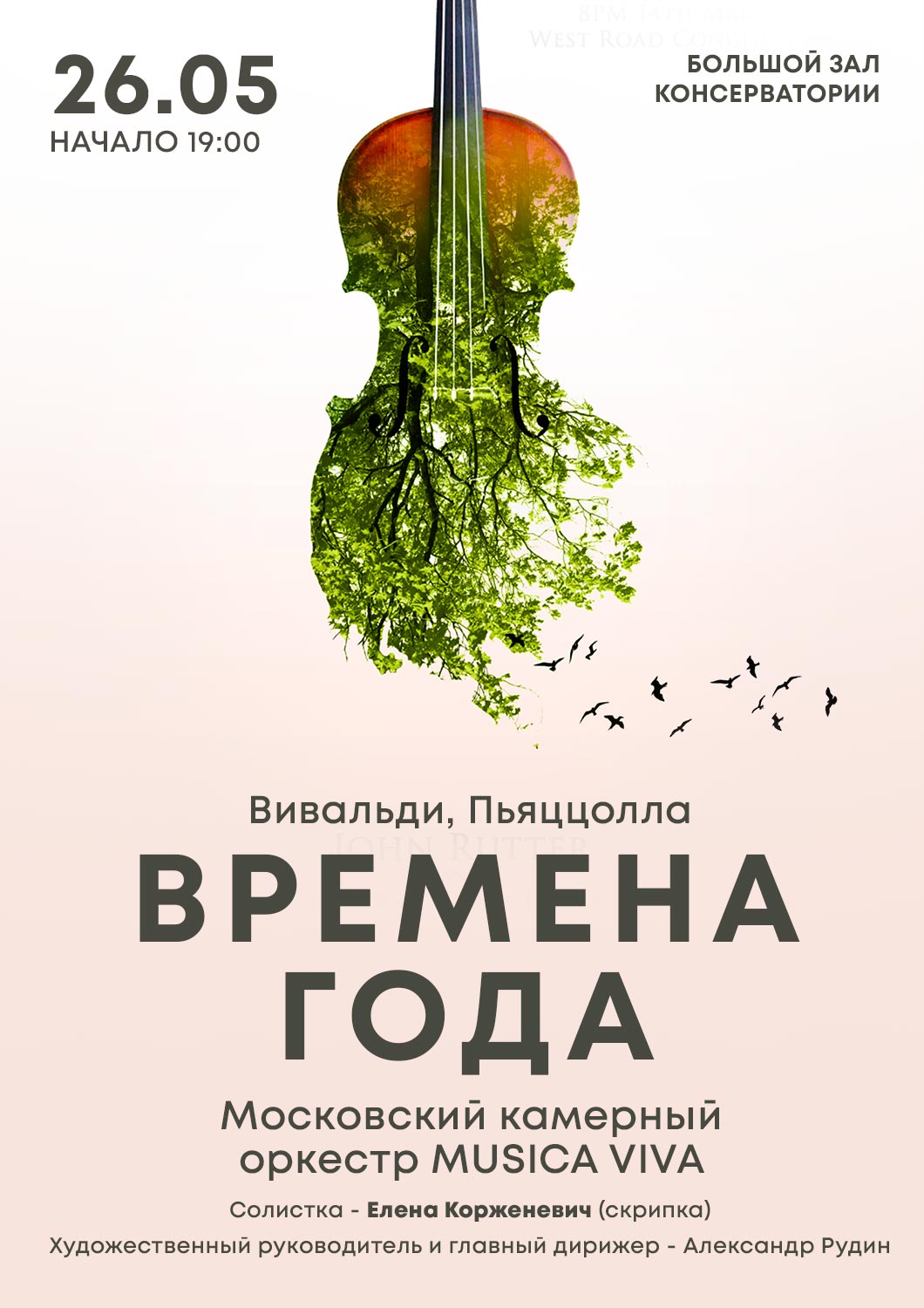
The Four Seasons: Vivaldi & Piazzolla — Musica Viva Moscow Chamber Orchestra


Great Hall of the Conservatory